

As Everything Is Forgotten…
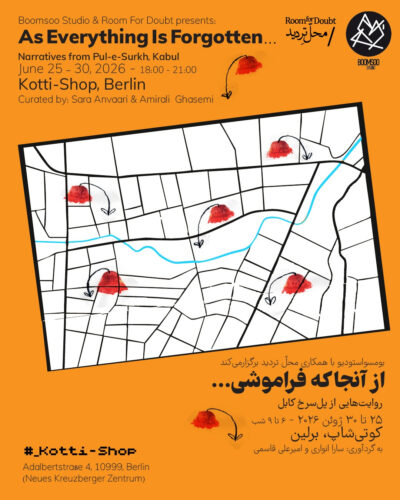
Website of the project:
https://pulisurkh.com/en/
Boomsoo Studio & Room For Doubt present:
As Everything Is Forgotten…
Narratives from Pul-e-Surkh, Kabul
June 25 – 30, 2026
Kotti-Shop, Berlin
.
Curated by: Sara Anvari & Amirali Ghasemi
Participating Artists:
Mohammad Shahab Eslami, Mohammadreza Yamak, Mohsen Tasheh, Aria Khalil, Tayeb Ataei.
.
Featuring Narratives by:
Hassan Azarmehr, Ahmad Imami, Tareq Qassemi, Sadeq Naseri, Mukhtar Wafayee
Alongside anonymous narratives and voices
.
Audio Archive Editing: Behnaz Habibinia
Graphic Design: Amirali Ghasemi
Web Design & Development: Soheil Eidy
.
Visiting Hours: Daily, 6:00 PM to 9:00 PM
.
With Special Thanks to:
Amir Afshar, Bahar Ahmadifard, Arash Dehghani, Maryam Kouhestani, Mohammad Aghazaki.
.
Today's Pul-e-Surkh, in the absence of those who breathed life into it, has been reduced to a physical shell that, on the surface, is emptied of its former meaning. Yet, this geography, beyond the concrete blocks and newly emerged commercial towers, has been recreated as a cultural ecosystem within minds and collective memory. Although the physical body of the city has taken on an "amnesic" form through the eradication of its gathering spaces and the installation of imposed symbols, Pul-e-Surkh continues to pulse as a "lived archive"; an ecosystem that has merely shifted its form of existence to transcend geographical boundaries, continuing its symbolic life through fluid narratives, embodied memories, and unfinished witnesses.
Today, Pul-e-Surkh is no longer a fixed geographical coordinate; it is a fluid and scattered geography, fragments of which breathe in Kabul, Tehran, London, Hamburg, Toronto, Berlin, and beyond. The photographs, sounds, books, and narratives that traveled in the suitcases of this neighborhood's former residents now continue another form of this space's life in exile—a life that flows beyond the physical body, within embodied memories.
The project "As Everything Is Forgotten…" began from this very point; from the question: how can one trace the footprints of a cultural ecosystem when its lifeblood, namely, its people, are no longer present in that space? In the first phase of this project in Tehran, we sought to gather a portion of this multifaceted memory through interviews, family photographs, and sounds that held no place in official archives. But the further we progressed, the clearer it became that this archive could not remain confined within the borders of a single city.
Pul-e-Surkh itself is the product of displacement, migration, and historical ruptures; therefore, it is only logical that its memory, too, is scattered across different corners of the world. For this reason, the project continues its journey in cities that currently host a fraction of this ecosystem's former inhabitants. Berlin is one of these key stations, not only because it is home to many people from Afghanistan, but also because the city itself carries a long and profound experience of migration, displacement, memory, and reconstruction within its core. What sprouted in Tehran now extends into Berlin, to summon a life that still flows within the narratives of unfinished witnesses and the layers of personal archives.
We have defined the archive not as a closed repository meant merely for storing documents, but rather as an atmosphere for gathering, dialogue, and participation. A part of this project is dedicated to recording and preserving lived testimonies—ranging from family photos and letters to ambient sounds and oral narratives- those very fragments that official memory has not been eager to record. However, this collection transforms into a "living archive" solely through your presence and intervention. We invite you, if you have preserved any objects, mementos, or traces of your lived experience in Pul-e-Surkh, to share them with this archive. Each piece of this scattered puzzle illuminates a corner of this space's collective memory, helping to complete a narrative that is still taking shape within the hidden layers of memories and geographies.
Kotti-Shop
Adalbertstraße 4, 10999, Berlin
(Neues Kreuzberger Zentrum)